
Cosmos and Fairyland: New Paintings from the Blue Mountains
There are moments in an artist’s life when landscape and imagination meet so completely that the work seems to come from somewhere just beyond conscious reach. My time here in the Blue Mountains has felt like that — a meeting point, a threshold, a place where memory, history, and wonder gather in unexpected ways.
This month, I’ve been working on two pairs of paintings created during my residency:
one diptych shaped by awe at an extraordinary landscape,
and another rooted in movement, native flowers, and old stories carried in the night sky.
Both threads were seeded long before I arrived.
1. The Fairyland Diptych: Seeing the Landscape Through Georgiana Malloy’s Eyes
In an earlier blog post, I wrote about Georgiana Malloy — the 19th-century botanist whose writings described the Australian landscape as “fairy land,” a place so alive with unfamiliar beauty that she felt surrounded by enchantment.
I’ve held that idea close while walking here: the sense of a world that is recognisable yet utterly other, where the light behaves differently, where plants shrug off the familiar logic of European botanica and insist on being themselves.
This first diptych grew from that feeling.
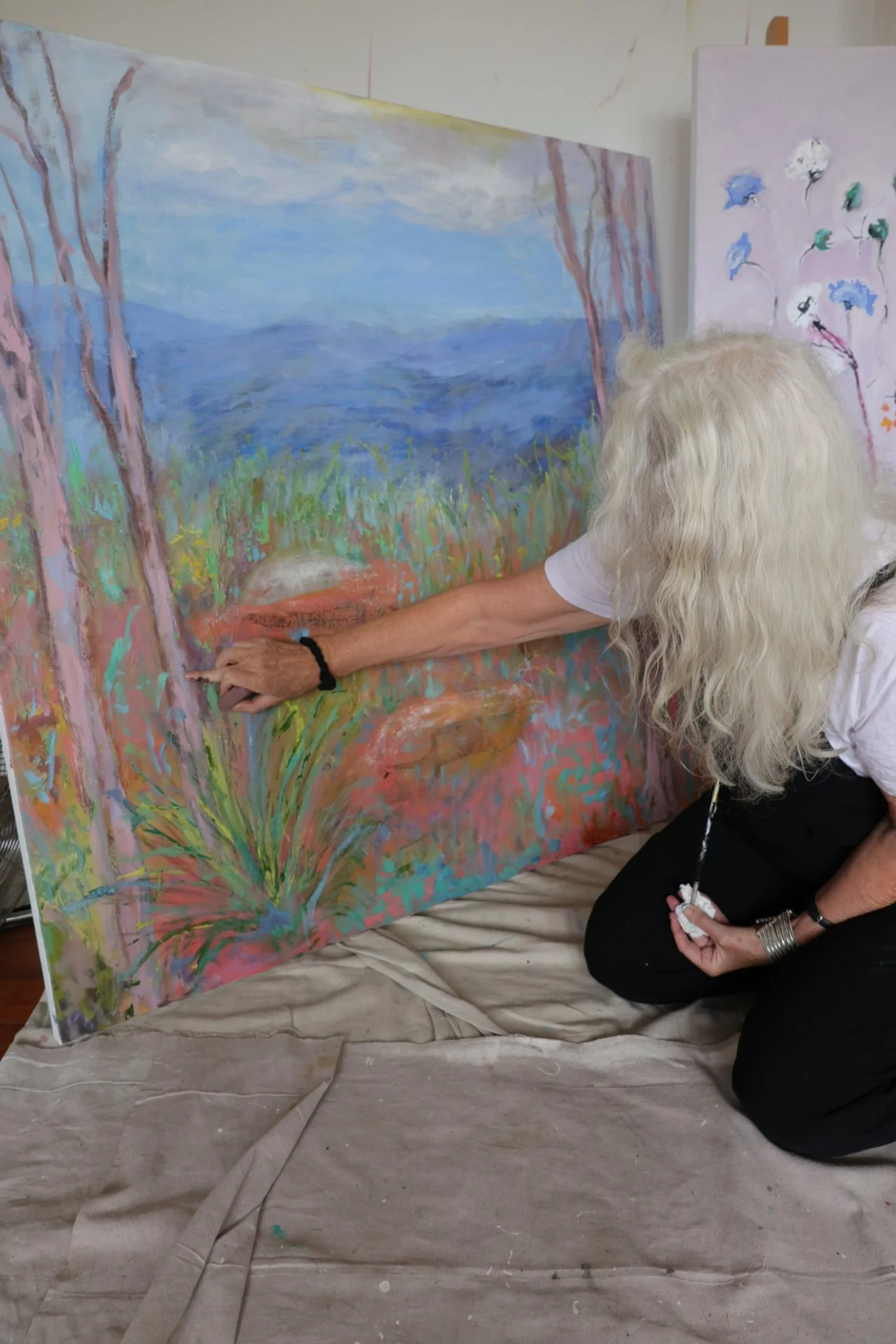
Photo credit Amber Hearn
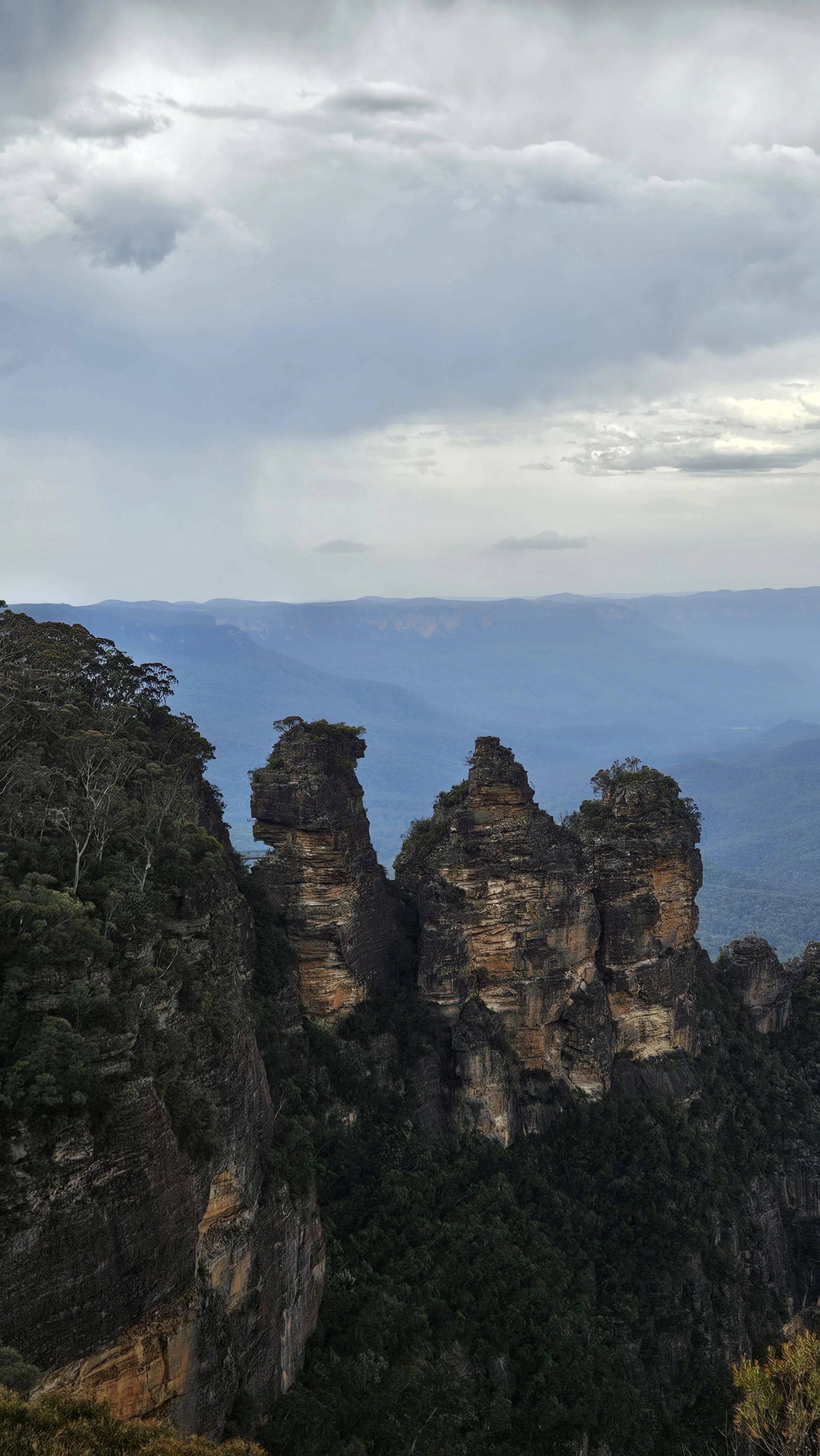
The paintings are created for a specific person who lives within this landscape — someone who truly sees its strangeness and splendour, who moves through it with a botanist’s curiosity and a child’s sense of wonder. I wanted to paint not only what the Blue Mountains look like, but what they feel like: the vertiginous depth of the valleys, the endless shift of weather, the way eucalyptus haze softens the world into powdery blues.
They are, in a way, a visual echo of Georgiana Malloy’s “fairy land” — a reminder that encountering a new landscape is always a form of re-enchantment.
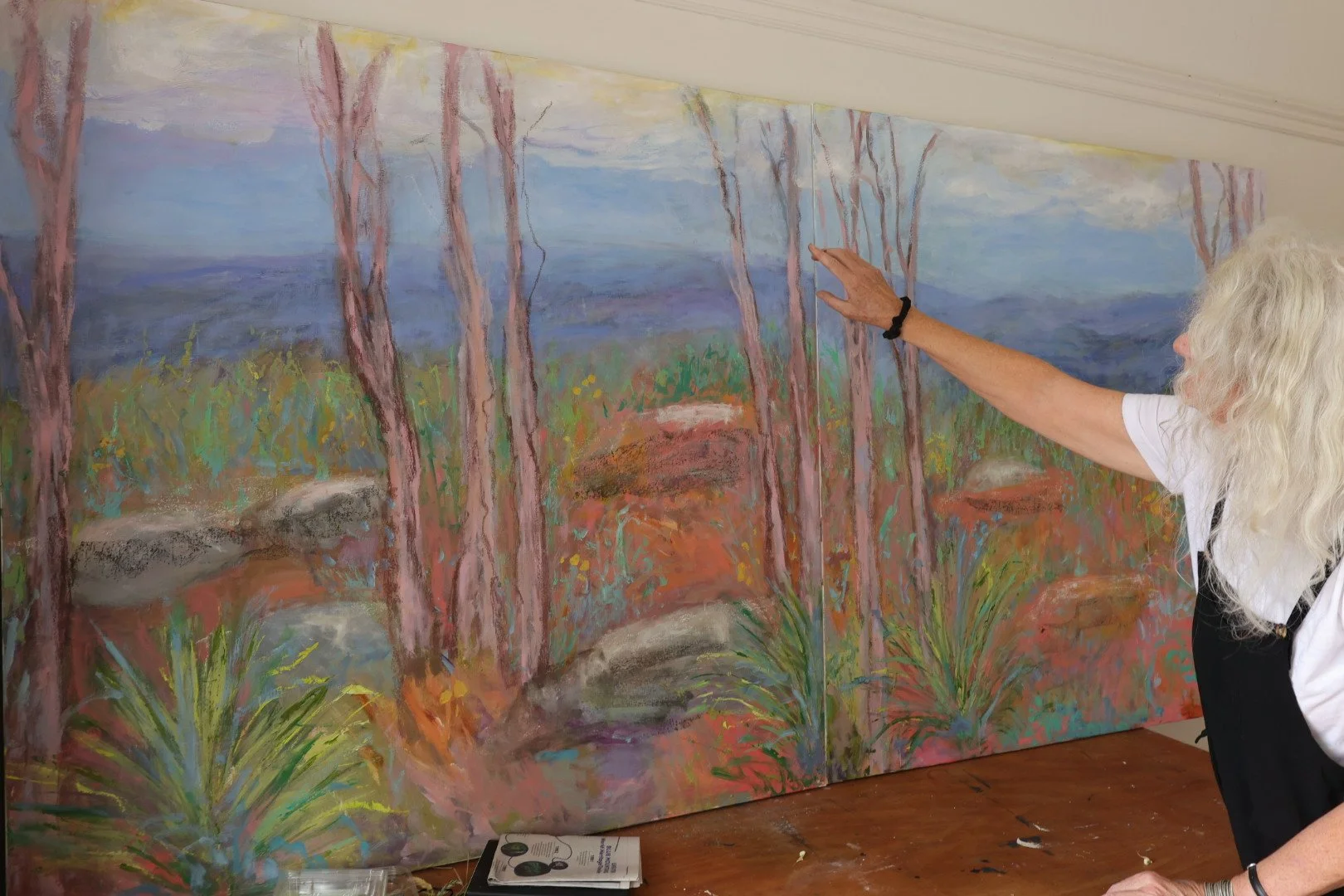
Photo credit Amber Hearn
2. COSMOS: A Diptych of Wild Flowers, Movement, and the Seven Sisters
The second set of paintings began in an entirely different way.
Just next door to the residency is a florist specialising in Australian native plants. I chose stems not for botanical rarity, but for their movement — flowers whose gestures suggested wind, direction, rhythm. I made many drawings first, letting the plants teach me their lines. The paintings that followed are very much drawings in colour: loose, calligraphic, rhythmic.
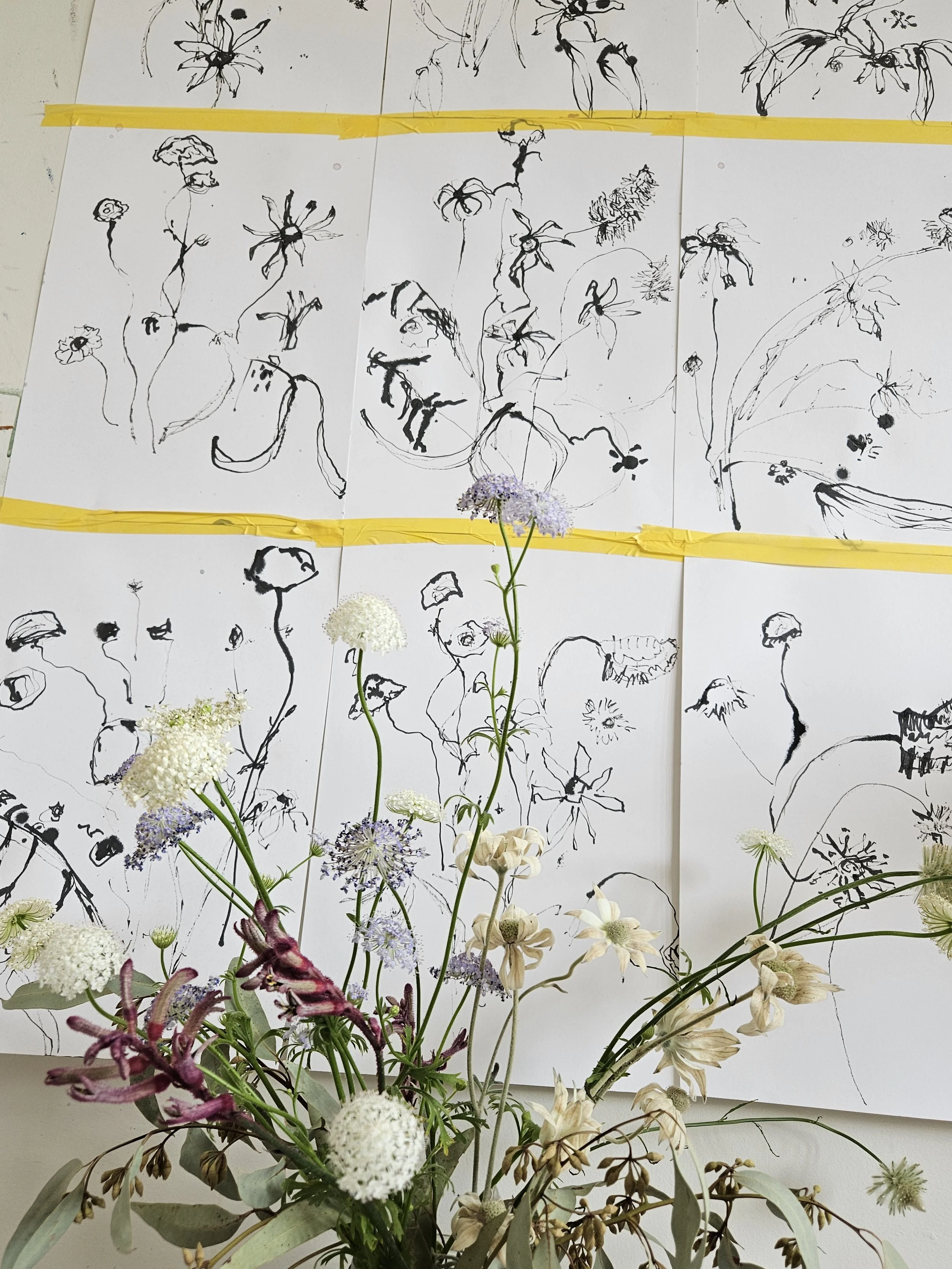
While making these works, I spent a day in the Art Gallery of New South Wales, immersed in Indigenous Australian artists paintings. The experience left its mark — not in technique, but in attention. the artists often paint from above, from within, and across time all at once. Stories become constellations. Plants become pathways. The land becomes a map of belonging.
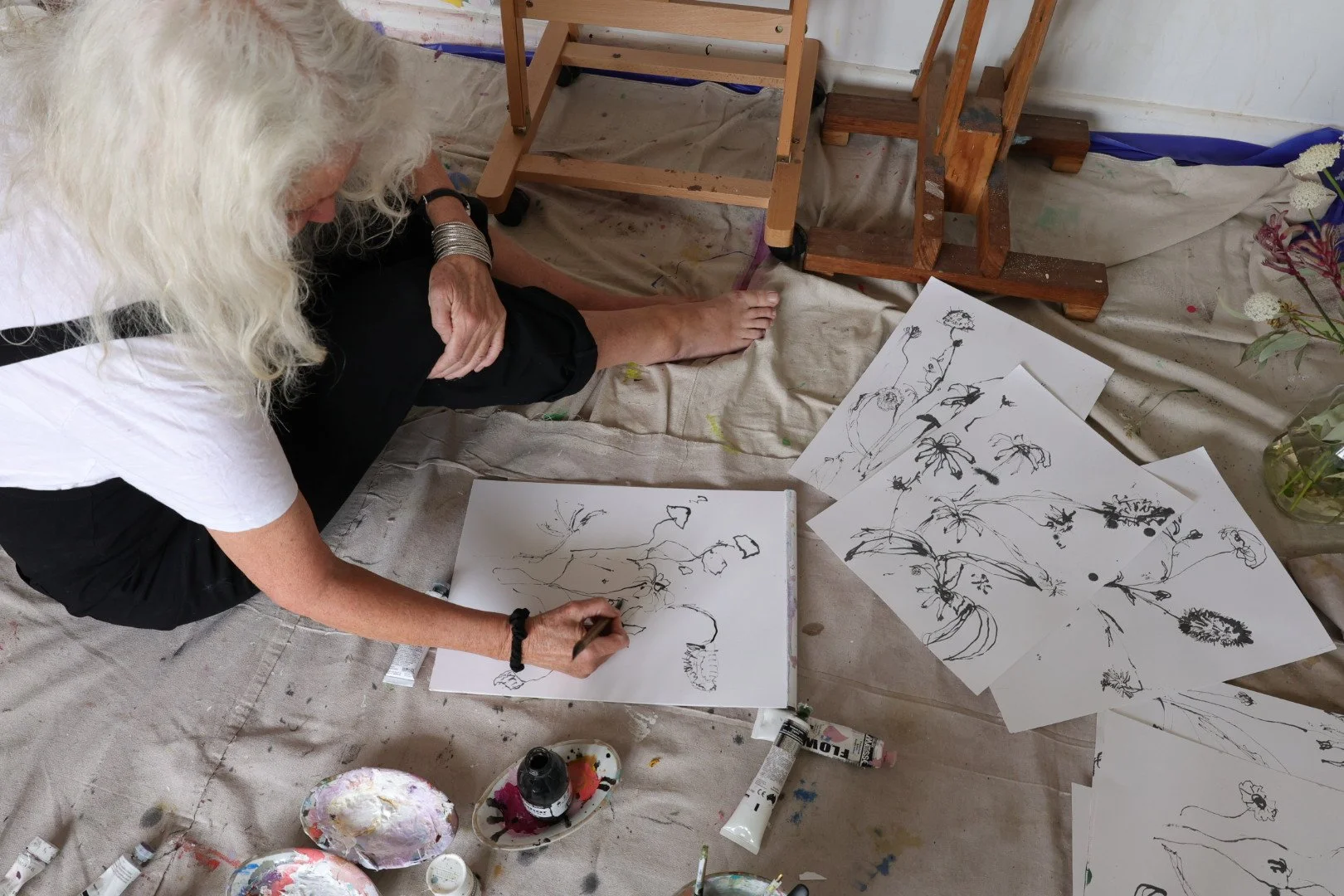
Photo credit Amber Hearn
One particular subject reappeared often and stayed with me: paintings of the Seven Sisters, a story shared across many First Nations cultures and tied to the Pleiades constellation. When I returned to the studio, I noticed that I, too, had gathered seven main flowers.
The name of this second diptych came easily:
Cosmos.
The flowers as stars.
The movement as orbit.
The story as something carried.
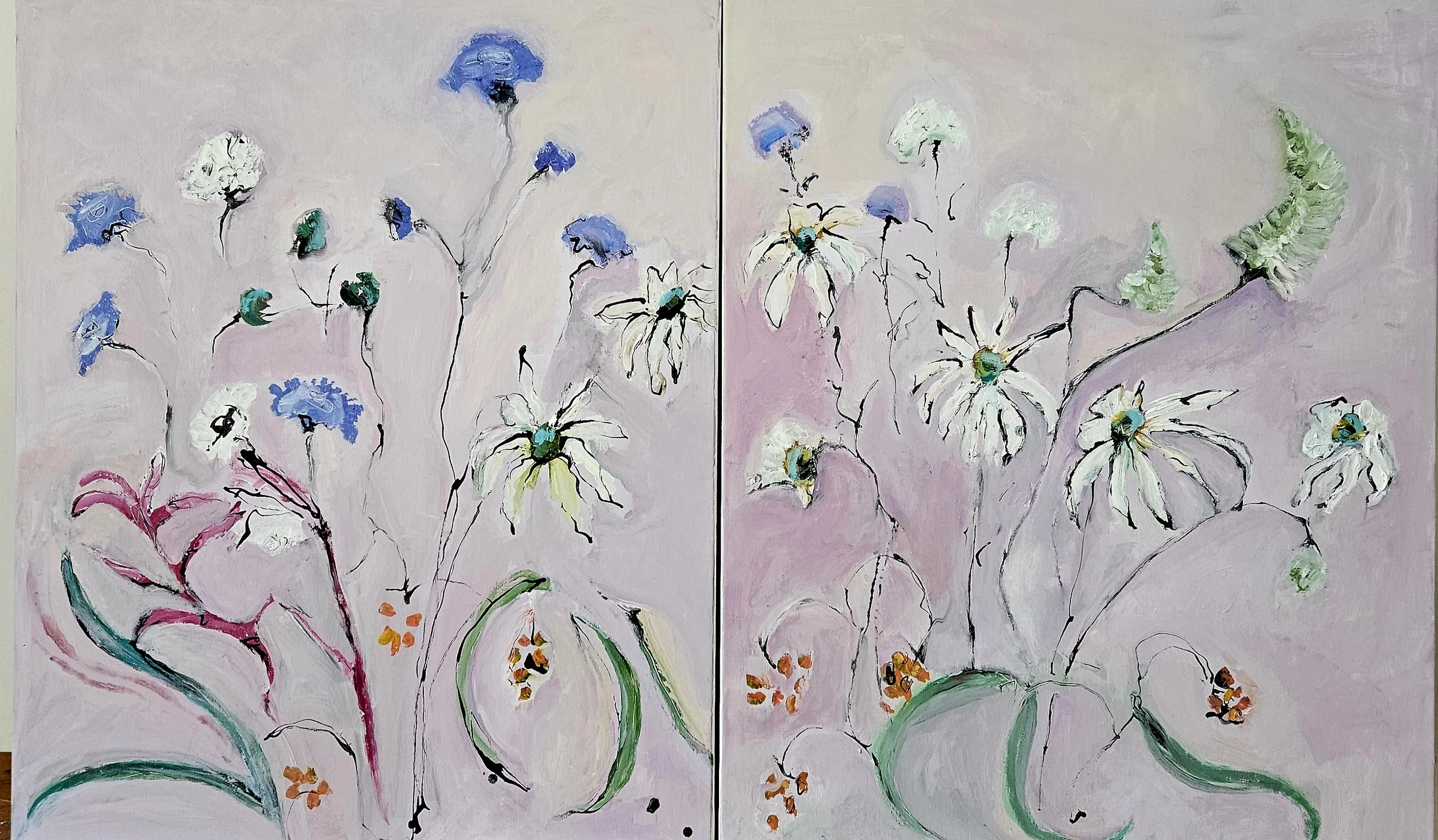
Cosmos, 2025
These paintings connect back to earlier themes in my work: women of flowers, belonging, ecology, and the different ways cultures read meaning in plants.
3. Carrying Forward Two Lines of Influence
Both diptychs grow from different kinds of influence:
Georgiana Malloy, whose wonder at Western Australian plants helped shape botanical history and who reminds me how deeply the experience of landscape can transform the self.
Indigenous Australian artists, whose paintings hold stories that stretch across land, sky, time, and community; who see plants as part of a living cosmology rather than isolated subjects.
In their own way, the four paintings from this residency sit between these two worlds - balancing fairyland and cosmos, awe and movement, earth and sky.
They also mark a continuation of my long-standing fascination with “women of flowers”: stories held in petals, mythologies rooted in plants, and the ways we understand the world through the natural forms around us.
4. Looking Ahead
These works are my first response to this place, a beginning. I suspect the Blue Mountains will continue to work their way into future paintings, long after I’ve left.
For now, I’m grateful for the chance to sit in a new landscape, listen to its colours, and try to translate something of its wonder onto the canvas.
More from the blog …


The Enchantment Of Bluebells